

The technique you choose determines how much control you have over every frame, how long production takes, and what kinds of stories your budget can actually support. 2D hand-drawn animation gives you total expressive control at the cost of enormous labor. 3D computer animation gives you consistency and revisability at the cost of building an entire digital world before you can shoot a single frame. Stop-motion gives you tactile physicality at the cost of a painstaking frame-by-frame process where a single second of screen time can take hours. Motion graphics and cut-out rigs give you speed and cheap iteration at the cost of organic movement. The rest of this page walks through how each approach works mechanically, what decisions you face in what order, and what each choice costs you in time, money, and creative range.
How the core animation techniques differ in production mechanics
Every animation technique is a variation on the same problem: creating the illusion of continuous movement from discrete images. What separates the techniques is where the images come from and how much control you have over each one.
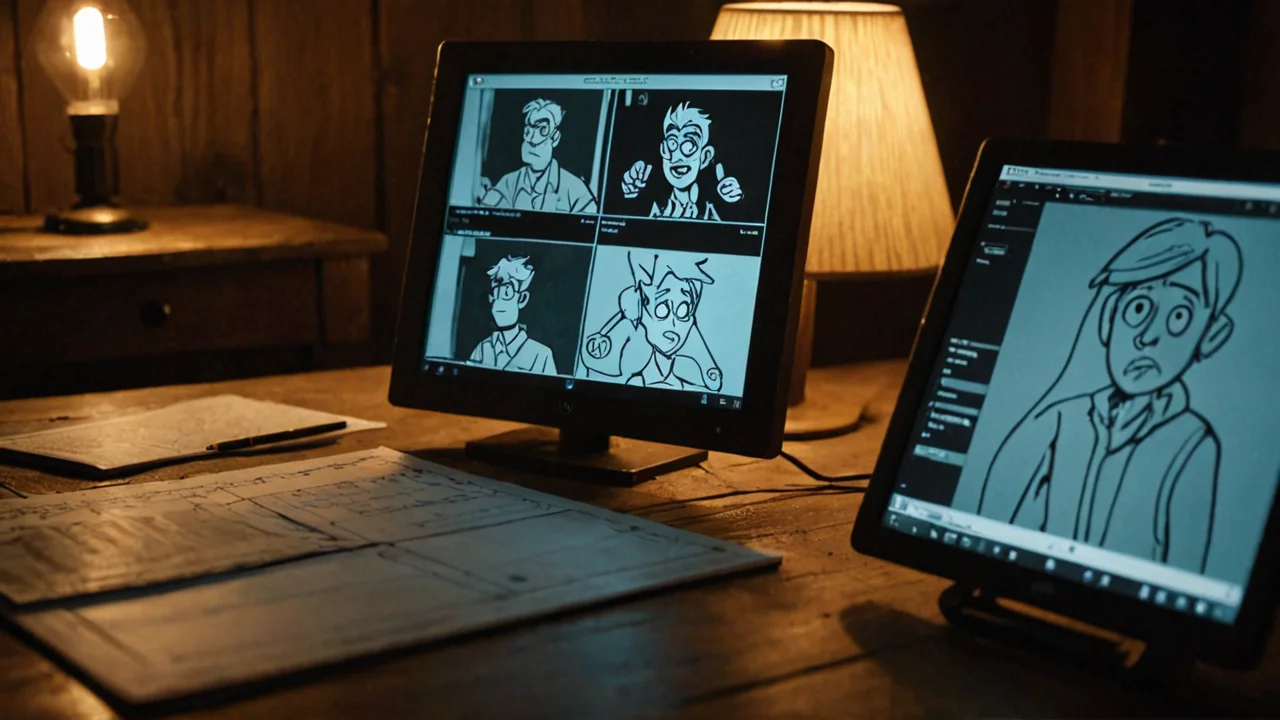
Traditional 2D animation is drawn by hand, frame by frame, either on paper or in a digital drawing program. A standard rate is 24 frames per second on film, though animators frequently draw "on twos" or "on threes" — meaning each drawing is held for two or three frames — to reduce the total drawing count while maintaining acceptable smoothness. The key mechanical fact is that every frame is an independent creative decision. You can change a character's expression, squash a form, exaggerate a pose, or break a line in ways that no other technique permits as fluidly. The cost is that a skilled animator produces only a small number of finished seconds per week, and every revision means redrawing.
3D computer animation works from a completely different premise. You build a digital puppet — a rigged mesh with a skeleton — and then pose it in a virtual space. The software calculates in-between frames automatically via interpolation. This means the animator's job is to set key poses and control curves, not to draw every frame. The trade-off is front-loaded: before you animate anything, you need models, textures, rigs, lighting setups, and often a full environment. A small team can spend weeks or months building assets before a single second of performance exists. Once that infrastructure is in place, though, revision is cheap — you can adjust a pose, re-time a sequence, or change a camera angle without starting over.
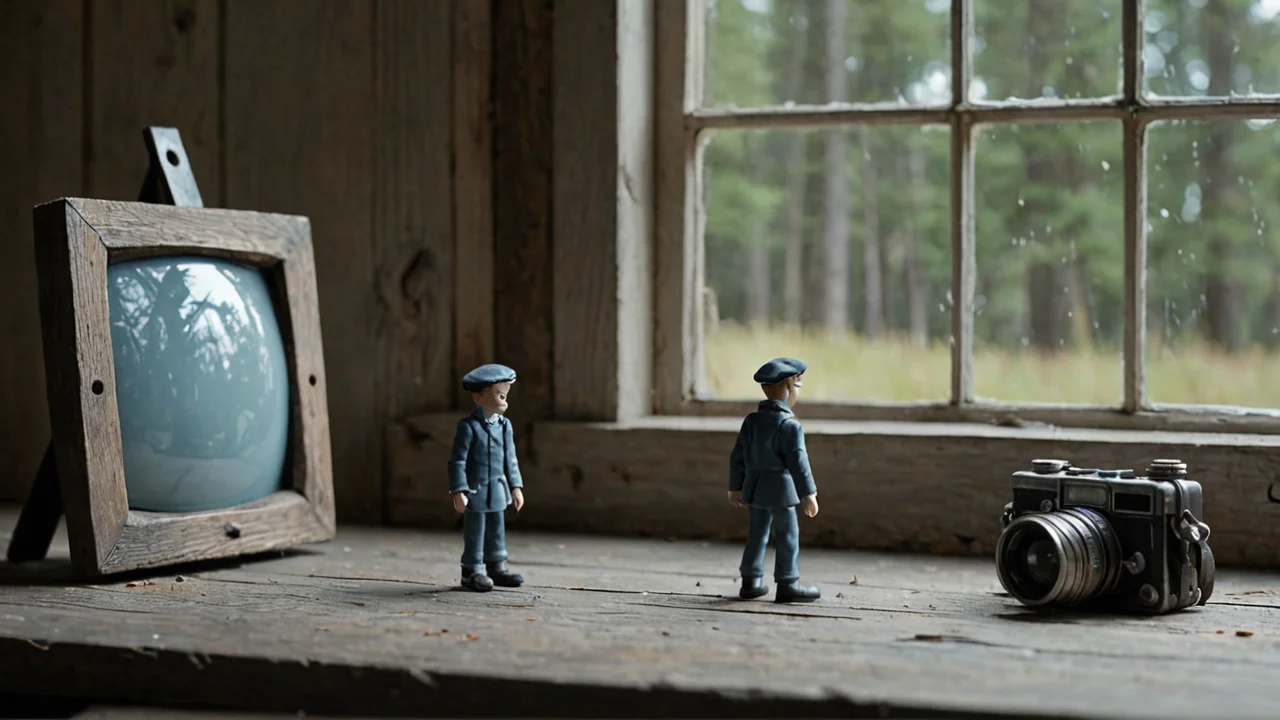
Stop-motion animation sits between these poles. You build or sculpt a physical object, place it in a real set under real lights, and photograph it one frame at a time, moving the object slightly between exposures. The result has a tangible weight and texture that CG struggles to replicate convincingly — real shadows, real imperfections, real material behavior. The cost is that you cannot undo. If you knock over a set piece halfway through a shot, you reshoot. If a puppet's armature breaks, production stops while you repair or rebuild it. Every second of screen time requires a physical performance repeated dozens of times, and the animator's body is part of the toolset.
Cut-out and puppet-based 2D animation — whether physical paper cut-outs or digital rigs — uses pre-drawn parts that are manipulated rather than redrawn. A character's head, torso, and limbs are separate assets connected by pivots. This is dramatically faster than full frame-by-frame drawing because you never redraw the same element twice. The limitation is visible almost immediately: movement becomes hinge-like, and extreme perspective shifts or organic deformation are difficult without building additional assets. Motion graphics occupies similar territory, using keyframed transformations of vector shapes or text, and it excels at explanatory sequences, titles, and interface animation but rarely convinces as character performance.
Choosing a technique: the decisions that come first
The first decision is not aesthetic — it is what the project can afford to iterate on. Every technique has a different cost curve, and the curve shapes what kind of story you can tell.
2D hand-drawn animation has a high per-frame cost that stays roughly constant throughout production. A character walking across a room costs the same to animate in week one as in week forty. This means the technique punishes length. A short film is feasible for a small team; a feature requires either a large studio or years of production. It also means that revision is expensive at every stage. If the director changes a character design after animation begins, every affected frame must be redrawn. The compensation is that the animator has direct, immediate control over the image — you draw exactly what you want, and the expressiveness of hand-drawn line and shape is difficult to match.
3D animation inverts this. The per-frame cost is low once the pipeline exists, but the setup cost is enormous. A character model, rig, and texture set can take a team weeks. A full environment — terrain, props, lighting — can take months. This means the technique rewards planning and punishes late-stage conceptual changes. If you decide halfway through production that your character should have a different body type, you are not redrawing frames; you are rebuilding a rig and re-targeting animation data. The compensation is that once the pipeline is running, you can produce long sequences efficiently, change camera angles freely, and revise timing without touching the underlying assets.
Stop-motion is the most expensive technique per second of finished footage for most independent productions. The physical build — puppets, sets, props, spare parts — is substantial, and the shooting process is slow. A single animator on a stop-motion shot might complete a few seconds of usable footage in a day, and that is before editing, compositing, and cleanup. The technique also demands physical space: a workshop for building, a stage for shooting, and storage for sets and puppets. The return is a visual quality that audiences read as handcrafted and immediate. For certain stories — particularly those with a tactile, slightly uncanny, or deliberately artificial quality — stop-motion delivers something CG cannot.
Cut-out and motion graphics are the cheapest to iterate on. Because you are manipulating pre-built assets, you can re-time, re-pose, and re-composite in minutes. This makes the technique well-suited to explainer content, title sequences, and short-form work where the message matters more than organic character performance. The limitation is expressive range: cut-out characters do not breathe, squash, or deform naturally, and audiences notice. For a talking-head explainer, that is fine. For a character-driven narrative, it rarely is.
The frame rate and timing decisions that define the look
The frame rate you choose is not just a technical specification — it is a stylistic decision that changes how the audience reads motion.
Standard film and television production in the U.S. uses 24 frames per second. Animators working in 2D frequently draw "on twos" — 12 distinct drawings per second, each held for two frames — because it halves the drawing count while retaining a smooth enough appearance. Drawing "on ones" (24 distinct drawings per second) produces noticeably smoother motion but doubles the labor. The choice is visible: on-twos animation has a slight stutter that reads as stylized and energetic, while on-ones reads as fluid and expensive. Neither is inherently better; the decision depends on the project's tone and budget.
3D animation is typically authored at 24 fps as well, but because the software interpolates between key poses, the animator controls timing through curve editing rather than frame-by-frame drawing. This means you can produce smooth motion at any effective rate without additional labor — but it also means that "smoothness" is the default, and achieving a deliberately snappy or stylized timing requires active intervention in the interpolation curves.
Stop-motion is almost always shot on ones or twos depending on the desired fluidity and the animator's patience. Shooting on twos is common because it halves the number of physical adjustments required, but it produces a characteristic slight jerkiness that audiences associate with the technique. Shooting on ones produces smoother results but doubles the shooting time. The decision affects not just the look but the production schedule: a shot that takes one day on twos takes two on ones, and that difference compounds across an entire film.
Motion graphics and cut-out animation often run at whatever frame rate the final delivery requires — 24, 25, or 30 fps depending on the platform — and because the animation is generated from keyframes, the frame rate is largely a delivery setting rather than a creative constraint. This is one of the technique's advantages: you can change the output frame rate without redoing the animation.
Content standards and ratings that affect animated work
Animation is not exempt from broadcast and film content regulation, and the rules differ by distribution channel in ways that directly affect what you can show and when.
On U.S. broadcast television and radio, indecent and profane content is prohibited between 6:00 a.m. and 10:00 p.m. — the hours when children are most likely to be in the audience. This is the FCC's safe-harbor framework. Indecent content is material that portrays sexual or excretory organs or activities in a patently offensive way but does not meet the full legal test for obscenity. Profane content is language so grossly offensive to members of the public who actually hear it as to amount to a nuisance, often including vulgar expletives. Both are restricted during those daytime and early-evening hours. Obscene content — material that appeals to the average person's prurient interest, depicts or describes sexual conduct in a patently offensive way, and taken as a whole lacks serious literary, artistic, political, or scientific value — is prohibited on broadcast and cable at all times.
For cable systems, the legal penalty for transmitting obscene material is a fine under Title 18, imprisonment of not more than 2 years, or both. This is a criminal standard, not a scheduling restriction, and it applies regardless of the hour. The practical implication for animators is that broadcast and cable distribution impose content limits that streaming platforms largely do not, and those limits are tied to the time of day for indecent and profane material but not for obscene material.
For theatrical and home-video distribution, the Motion Picture Association rating system applies. An NC-17 rating is the highest MPA rating, indicating content appropriate only for adults; no one 17 or under is admitted, and the rating is often triggered by explicit sexual activity or other elements considered patently adult. The rating board describes an NC-17 film as one that most parents would consider patently too adult for their children 17 and under. For animated work, this matters most for adult-oriented animation — the rating determines which theaters will screen it and which retailers will stock it, and an NC-17 rating substantially narrows distribution compared to an R rating.
Documentary animation faces an additional structural rule if it is submitted to the Academy Awards. Documentary Feature is defined as motion pictures with a running time of more than 40 minutes; Documentary Short Subject is defined as motion pictures with a running time of 40 minutes or less. This threshold determines which category a film competes in, and it is a hard cutoff — a 40-minute film is a short, and a 41-minute film is a feature. For animators working in documentary or non-fiction modes, the runtime decision is also a category decision.
Sound, voice, and the timing relationship in animation
Animation is almost always built to a soundtrack rather than recorded to picture, and this reverses the production order familiar from live action.
In live-action filmmaking, dialogue is typically recorded on set and the picture is edited to match. In animation, voice performances are usually recorded first, and the animation is built to match the existing audio. This means the animator's timing is dictated by the voice track: mouth shapes, gestures, and pauses are synchronized to a performance that already exists. The advantage is that the voice actor's performance drives the character rather than being constrained by pre-visualized animation. The disadvantage is that changing dialogue late in production requires re-animating the affected shots.
For 2D animation, this synchronization is done through exposure sheets — timing charts that map each frame to a specific sound or phoneme. The animator works from the voice track and the exposure sheet simultaneously, drawing mouth shapes that correspond to the recorded syllables. For 3D animation, the voice track is imported into the software and the animator poses the character's face and body against the waveform. Stop-motion animators often play the voice track aloud on set while shooting, adjusting puppet mouth shapes or body language frame by frame to match.
Music and sound effects follow a similar logic: they are typically finalized before or during animation rather than added afterward, because the animation must react to them. A character's footstep must land on the beat; a gesture must coincide with a sound cue. This is why animation production schedules often place sound design and scoring early rather than in post-production. The cost is that late changes to the soundtrack ripple through the animation, and the benefit is that the final product feels integrated rather than assembled.
When citing film or video in written work — including academic papers, critical essays, or production documentation — MLA style requires in-text citations of film or video recordings to include the relevant time or time ranges. This is a practical necessity in animation writing because specific moments matter: a particular frame, a cut, a timing choice. The citation format forces precision about when in the runtime the referenced material appears.
What each technique costs you, honestly
The honest comparison is not which technique is "best" but which technique's costs align with your project's constraints.
| Technique | Setup cost | Per-second cost | Revision cost | Expressive range |
|---|---|---|---|---|
| 2D hand-drawn | Low to moderate | High and constant | High at every stage | Broadest organic expression |
| 3D computer | Very high | Low once pipeline exists | Low after assets are built | High, but constrained by rig |
| Stop-motion | High (physical build) | Very high | Very high — no undo | Distinctive tactile quality |
| Cut-out / motion graphics | Low | Low | Very low | Limited organic movement |
2D hand-drawn animation costs you time in direct proportion to length, and it costs you flexibility in revision. A change to a character design after animation begins is not a tweak — it is a redraw. What you get in return is the most direct line between an animator's hand and the audience's eye. The technique is the right choice when the expressiveness of drawn line and shape is central to the project and when the length is manageable for the team.
3D animation costs you a long, expensive pre-production phase before any performance exists, and it costs you flexibility in fundamental design changes late in the process. What you get is consistency, revisability, and the ability to produce long sequences efficiently once the pipeline is running. The technique is the right choice when the project requires complex camera work, large environments, or a volume of footage that would be prohibitive to draw.
Stop-motion costs you physical space, physical build time, and the inability to undo. A broken puppet or a knocked-over set is a production delay, not a Ctrl+Z. What you get is a material presence that audiences read as real and handcrafted. The technique is the right choice when the story benefits from that tactility and when the production can absorb the schedule risk.
Cut-out and motion graphics cost you organic character performance and the subtle deformations that make movement feel alive. What you get is speed, cheap iteration, and the ability to produce explanatory or graphic content at a fraction of the cost of other techniques. The technique is the right choice when the message is informational or graphic rather than character-driven, and when the schedule demands rapid iteration.
The wrong choice is usually a mismatch between technique and constraint: a small team attempting full 2D hand-drawn animation on a feature-length schedule, or a character-driven narrative built in cut-out because it was cheaper. The technique should follow from what the project can afford to iterate on, how long it needs to be, and what kind of performance the story requires. Everything else — the software, the frame rate, the pipeline — is downstream of those three decisions.